
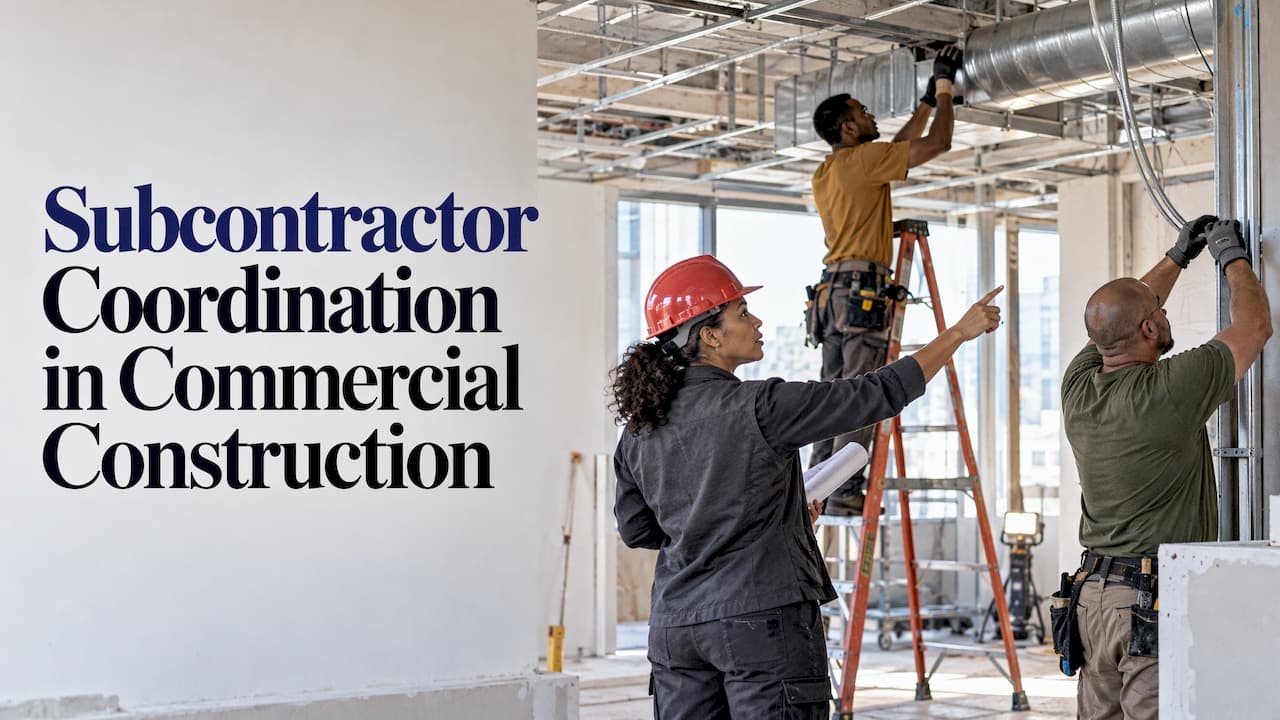
Subcontractor coordination is how a general contractor makes separate trade firms work as one team. It covers whose scope is whose, who is on site on which day, how the trades share tight spaces, and how every change reaches the people it affects. On a commercial project the general contractor owns this job. When it is done well, you see it in a schedule that holds, a budget with few surprises and finished work that needs little rework.
This guide explains what coordination involves, who is accountable, the routine that keeps trades on schedule, the problems that come up most, and how the work changes when an office, clinic or care facility stays open during construction.
TL;DR
- Subcontractor coordination means aligning trades' scopes, schedules, work areas, information, safety and quality so their work fits together.
- The general contractor is the single point of accountability. Subcontractors have no direct contract with the owner, and the contractor cannot hand coordination off to one of them.
- The core routine is a master schedule, a rolling two- to three-week lookahead, a weekly trade meeting and written records of every decision.
- Occupied buildings add a layer: outages, infection control, phasing and the operator's own calendar all have to be coordinated with the trades.
- Ask any contractor you are considering how they run the lookahead, handle conflicts between trades and plan around your operations.
Table of Contents
- What subcontractor coordination covers
- Who is responsible for coordinating subcontractors
- How a general contractor coordinates the trades day to day
- Common coordination problems and how to prevent them
- Coordinating subcontractors in an occupied building
- Our perspective on coordinating trades
- Coordination support from EBM
- Questions to ask your general contractor about coordination
- FAQ
- Sources
What subcontractor coordination covers
A commercial project is rarely built by one firm. A general contractor typically hires specialty firms for demolition, framing, drywall, mechanical, electrical, plumbing, flooring, painting and more. Procore's list of subcontractor types runs from site preparation and concrete through HVAC, electrical, drywall, painting and tile setting. In a subcontract arrangement, the main contractor sublets some or all of its obligations under the main contract, and RICS guidance on subcontracting notes that subcontracted work can reach 85 to 90 percent of the value of the main contract, with sometimes up to 100 subcontractors on one job.
With that many firms, the work of one trade depends on the trade before it and the trade after it. Procore describes trade coordination as planning, scheduling and managing trades for the full life of the project, with each trade's work sitting inside the same schedule and depending on what comes before and after.
In practice, coordination spans six areas:
| Area | The question it answers | Example |
|---|---|---|
| Scope | Who does what, and where does one trade stop? | Who patches the wall after the electrician cuts the chase? |
| Schedule | In what order, and when? | Rough-in inspections before drywall, finishes after paint |
| Space | Who needs this same area at the same time? | Plumbing, HVAC and electrical sharing one corridor ceiling |
| Information | Does everyone have current drawings and decisions? | A revised ceiling height reaching every trade, not just one |
| Safety | Do all crews follow the site rules? | Shared access routes and protection of occupied areas |
| Quality | Is work checked before it is hidden? | Verification before walls are closed |
ONES, writing on the subject, frames it the same way: organizing trade contractors so responsibilities, schedules, work areas, information, safety and quality activities fit together.
Time is only half of it
Most people think of coordination as scheduling. But Ron Winter Consulting points out that tight spaces, such as the overhead run down a corridor, force plumbing, HVAC, electrical, signaling and fire control to share the same space. That is spatial coordination, and it has to be solved on paper before crews arrive, not in the ceiling with a deadline looming.
Who is responsible for coordinating subcontractors
The general contractor. The subcontractor holds a contract with the contractor, not with you as the owner, and that shapes who answers for what.
Public owners write this rule down plainly. The University of Texas System's general conditions are the kind of document that makes the contractor solely responsible for scheduling and coordinating subcontractors and suppliers, and for routing their communication to the owner through the contractor. Hennepin County's Section 013100 specification goes further: the contractor is the prime coordinator, cannot delegate that responsibility to a subcontractor, and must resolve disputes between subcontractors over interference or the extent of work.
The AGC's MEP spatial coordination requirements show the same pattern at a smaller scale. The general contractor's coordination manager administers the coordination team, makes sure subcontractors take part and perform, and acts as final arbiter when the mechanical, electrical and plumbing trades cannot settle a conflict between themselves.
For an owner, this is the practical benefit of hiring a general contractor rather than contracting each trade yourself. You have one party to hold to the schedule and one voice to call. We cover that decision in more detail in our guide to hiring a general contractor versus subcontractors.
Contract language varies, so read your own agreement for how coordination duties, notices and change requests are assigned.
How a general contractor coordinates the trades day to day
Coordination is a set of habits, not a single document. Here is the routine we would expect on a well-run commercial job.
- Build the master schedule with the trades. The contractor lays out the whole project, usually as a critical path schedule, and sequences the trades so each can start when the previous one is done. Research from the Department of Transportation of the District of Columbia notes that subcontractors should be involved, to the extent the prime contractor permits, in planning and scheduling meetings, problem resolution and implementation of changes. People who will do the work often see sequencing problems first.
- Prepare a rolling lookahead. A practical coordination template from Subtrak describes a two- to three-week lookahead organized by area and trade, shared with subcontractor foremen at least a day before the weekly meeting.
- Hold a weekly coordination meeting. Walk through the lookahead, confirm manpower and scope, and capture each trade's commitments and constraints. The same template stresses documented agreements over informal conversations that get forgotten.
- Huddle daily on active jobs. Procore's subcontractor management tips recommend regular meetings such as daily jobsite huddles, plus schedule float so a small slip in one task does not automatically push the next.
- Resolve conflicts between trades quickly. The superintendent hears about the overlap, decides the sequence or the space, and records it.
- Verify before concealing. Rough-in work is inspected and approved before it disappears behind a wall or ceiling.
- Close out in order. Punch lists, final cleaning and turnover are scheduled like any other activity, not left to the last days.
Documentation protects everyone
Written records are not bureaucracy. A study in the ASCE Journal of Construction Engineering and Management describes a schedule control method led by the subcontractor, using trade-specific schedules and monthly updates with narratives. Its authors found that it improves communication with other participants and supports notice, resolution and, if needed, claims. The lesson for owners is straightforward: when schedules, constraints and decisions are written down as they happen, disagreements get settled during the project instead of after it.
Common coordination problems and how to prevent them
The search results for this topic repeat the same trouble spots. Here is how they typically show up and what usually prevents them.
| Problem | What it looks like | What prevents it |
|---|---|---|
| Overlapping or gapped scopes | Two trades price the same item, or neither does | Scope sheets that name boundaries, reviewed before award |
| Trades arriving out of order | Finishes start before rough-in is inspected | Sequenced master schedule and a weekly lookahead |
| Space conflicts | Ducts, pipe and conduit all claim the same ceiling | Coordination drawings reviewed before installation |
| Stale information | A trade builds from a superseded drawing | One controlled document set and logged changes |
| Unrecorded decisions | "We agreed on site" with no record | Meeting minutes and written confirmation of changes |
| Late discovery of constraints | A trade finds out about a shutdown the day before | Sharing constraints at the weekly meeting and in the lookahead |
| Rework after concealment | A wall is closed, then opened again | Inspection hold points before covering work |
Notice what these have in common: almost none is a craft failure. They are information failures. A good plumber can still lose a week because nobody told the plumber that the ceiling grid moved.
Coordinating subcontractors in an occupied building
Everything above gets harder when the building keeps operating. Offices, medical practices, dialysis clinics, nursing homes and senior living communities cannot simply stop. The contractor now coordinates not only trades with each other but trades with a living operation.
Phasing takes more time and more voices
HH Designers reports that a phased renovation of an occupied senior living community typically takes 30 to 50 percent longer than the same scope in an empty building. Their advice on who should be at the planning table is worth taking: the administrator, director of nursing, maintenance, marketing, the design team and the contractor, since a missing voice at the phasing stage tends to resurface later as change orders and complaints.
Outages and tie-ins need an owner decision
Niner Health explains that in occupied healthcare construction, the owner decides whether, when, for how long and where an outage happens, and on what conditions service returns, while the builder physically executes the tie-in. For the contractor, this means the plumbing, electrical or medical gas subcontractor's date is only as firm as the operator's approval. The same source describes an owner-side forum, meeting on the operation's rhythm, with infection prevention, nursing, facilities, life safety, security, the design team and the builder, empowered to approve outages and resequence phases.

Infection control and access apply to every trade
For hospital-type work, one phasing playbook lists entry criteria such as approved infection-control and interim life safety plans, hard barriers, verified negative pressure, construction-only routes, approved shutdown plans and infection-control training for all trade partners. Requirements differ by facility type and project, so confirm the plan with your infection-prevention and life-safety teams. What matters for coordination is that every subcontractor's foreman hears the rules before the first day, and new crews are briefed before they enter.

What this means for the schedule
A workable occupied-building schedule builds in the operator's calendar: shift changes, visiting hours, patient treatment times, deliveries and quiet periods. Noisy or dusty work goes where and when it disturbs the least. Short, frequent communication with the operator replaces surprises. That is the part of coordination that no software tool replaces.
Our perspective on coordinating trades
We have been building and renovating commercial spaces around Chicago since 2001, and most of our work happens in buildings that stay open. That has shaped how we think about coordination.
First, we treat coordination as the product, not a side task. Owners hire a general contractor because they want one accountable party between them and a dozen trades. So we run projects with hands-on project management and a clear line of communication from the owner to the superintendent to every foreman.
Second, we plan around the operation. In skilled nursing, senior living, dialysis and medical office work, the question is never only "when can the drywall crew start?" It is "what is happening on this floor, and who needs to know?" Our approach is to bring the operator's constraints into the schedule early, so they are inputs, not interruptions.
Third, we keep it simple and written down. A lookahead, a weekly meeting, and a record of every decision go a long way toward preventing the rework and finger-pointing that cost owners money.
If you are weighing contractors, ask each one how they would coordinate the trades on your specific building. The answer tells you more than a brochure does.
Krzysztof
Coordination support from EBM
Expert Building Maintenance, Inc. (EBM) is a commercial general contractor in Burr Ridge, Illinois, serving the Greater Chicago area, Illinois and the Midwest. Our services include project management, trade coordination and construction through final turnover, with a focus on renovations of occupied buildings and healthcare facility projects. Learn how we approach commercial construction management and coordination, or browse our full list of commercial construction services.

If you are planning an office buildout, a tenant improvement or a healthcare renovation, tell us about your building and your operating constraints. We will talk through how the work could be phased and coordinated. You can also see our recent projects or review a typical construction project timeline.
Questions to ask your general contractor about coordination
These questions help you compare contractors on what happens after the contract is signed.
- Who is my day-to-day contact on site? You want a named superintendent with authority over the trades, not a rotating cast.
- How do you run the lookahead and weekly meeting? Look for a specific rhythm and written minutes.
- How do you handle conflicts between trades? The contractor should be able to describe who decides and how it is recorded.
- How will you protect my operations? Ask about phasing, dust and noise control, access routes and outage planning.
- What do you need from us as the owner? Expect a clear answer: timely decisions, outage approvals, and access, for example.
- How are changes communicated and priced? Written change documentation is the safest answer.
If you are still choosing a firm, our guide to choosing a commercial general contractor in Illinois goes deeper, and our article on commercial interior renovation shows how coordination plays out on an interior project.
FAQ
What is subcontractor coordination in construction?
It is the structured process a general contractor uses to manage scheduling, communication, scope boundaries and performance of the specialty firms on a project, as Commercial Contractor Authority describes it. The goal is for each trade's work to fit with the work before and after it.
Who is responsible for subcontractor work?
Under typical prime contracts, the general contractor is responsible for coordinating subcontractors and for their work, as public owners' specifications spell out. The subcontractor has no direct contract with the owner. Your own contract controls the details, so review it with your attorney or project advisor.
What are common issues with subcontractors?
Most issues come from information gaps: unclear scope boundaries, trades arriving out of sequence, conflicts over shared space and decisions that were never written down. A rolling lookahead, a weekly meeting and written records prevent most of them.
Does coordination change when the building stays occupied?
Yes. The contractor must also coordinate outages, infection control, access routes and the operator's daily schedule, and phasing usually extends the timeline. Niner Health notes that the owner decides on outages while the builder carries out the work, so decisions have to move quickly between both sides.
Sources
- Trade Coordination: The Contractor's Guide, Procore
- Types of Subcontractors in Construction, Procore
- 9 Tips for Effective Subcontractor Management, Procore
- Subcontracting, RICS
- What Does Subcontractor Coordination Involve, ONES
- Scheduling for Subcontractors, Ron Winter Consulting
- Section 013100 Project Management and Coordination, Hennepin County
- MEP Spatial Coordination Requirements, AGC
- Construction Management Manual, DDOT
- Subcontractor Coordination SOP, Subtrak
- Subcontractor Schedule Control Method, ASCE Journal of Construction Engineering and Management
- Renovating an Occupied Senior Living Facility, HH Designers
- Building inside an occupied healthcare facility, Niner Health
- Hospital Construction Phasing Playbook
- Subcontractor Coordination in Commercial Contracting, Commercial Contractor Authority