
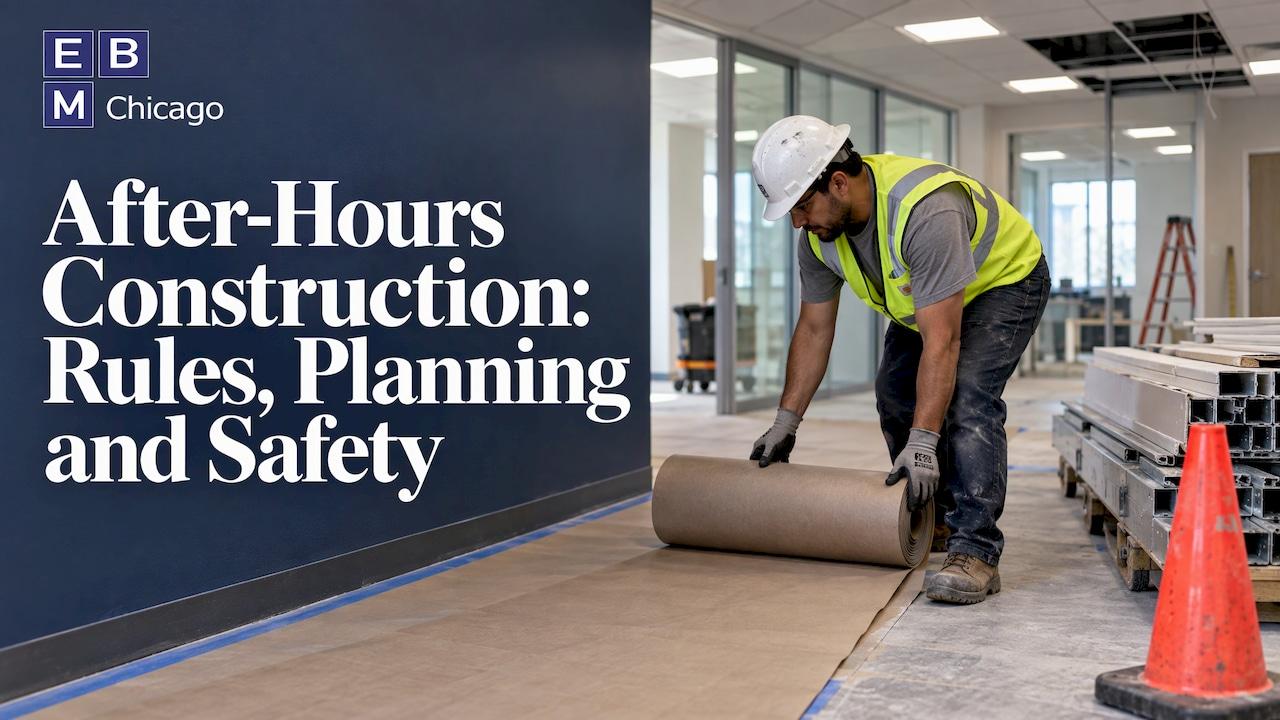
After-hours construction is work done outside a municipality's or building's standard working window, usually evenings, nights, weekends and holidays, so that a clinic, office or care facility can keep running during the day. It is allowed almost everywhere, but never automatically. The city decides which hours count as normal, the building decides which tasks must move to off-hours, and your contractor decides whether the schedule survives both. The owners who get it right treat night work as a permitting and coordination problem first and a construction problem second. That is where a general contractor that renovates occupied buildings earns its fee.
Key Takeaways
- "Normal hours" are set locally. New York City, Washington, D.C. and San Francisco all define them differently, and work outside them needs a permit, variance or written approval.
- Your building's own rules can be stricter than the city's. A Chicago high-rise's published rules, for example, push noisy demolition and coring to evenings and require advance tenant notice.
- Night work adds real hazards: lower visibility, fatigue and tighter noise limits. Plan lighting, hearing protection and crew rotation before the first shift.
- Most delays come from paperwork and notice periods, not from construction. Build the lead times into the schedule from day one.
- One accountable general contractor who coordinates trades, building management and tenants keeps off-hours work from turning into off-schedule work.
Table of Contents
- What counts as after-hours construction
- Why owners choose night and off-hours work
- Permits, variances and noise limits by city
- Your building's rules come first in a leased or multi-tenant property
- Planning an after-hours schedule that holds
- Safety and security at night
- Keeping cost and schedule under control
- How a general contractor keeps off-hours work on track
- FAQ
What counts as after-hours construction
There is no national definition. Each city or building sets its own window, and anything outside it is "after hours." Washington, D.C.'s Department of Buildings, for instance, treats work beyond Monday through Saturday, 7 a.m. to 7 p.m., or on legal holidays as after-hours construction. New York City allows work 7 a.m. to 6 p.m. on weekdays and requires after-hours authorization at all other times, weekends included.
Chicago's noise ordinance, as published in its municipal code, restricts mechanical equipment and tools used in building, construction, repair or demolition between 8 p.m. and 8 a.m. within 600 feet of a residential building or hospital, with an exception for emergency work. Because that 600-foot radius includes hospitals, it matters to healthcare operators and anyone building near one. Municipal codes are amended, so confirm the current text with the City of Chicago or your suburb's building department before you commit to a schedule. Many Illinois suburbs have their own hour limits.
In practice, after-hours work falls into three groups:
- Noisy or disruptive tasks in an occupied building. Demolition, floor coring, anchoring into slabs and similar work moves to evenings so tenants, patients or staff are not affected.
- Work that needs a space empty. Ceiling and flooring work in a clinic corridor, a utility shutdown, or tie-ins to building systems often need the space vacant.
- Short-deadline projects. When downtime costs revenue, owners add shifts to compress the calendar.
The approach is well established. In one widely reported example, a contractor performed most of the Empire State Building's 102nd-floor observation deck renovation between 2 a.m. and 7 a.m. so the attraction could keep operating. An industry representative quoted in the same report noted that after-hours permits are critical for school projects, where daytime disruption can compromise the health and safety of students, teachers and staff. Healthcare and senior living operators face the same logic.
Why owners choose night and off-hours work
The reasons are practical:
- Protecting revenue. A medical office, retail tenant or dialysis center earns only while it is open. Moving loud or dusty work to off-hours keeps treatment chairs, desks or sales floors in use.
- Protecting occupants. Residents of a skilled nursing facility or senior living community are sensitive to noise, dust and odor. Work that cannot be contained is better done when fewer people are present.
- Meeting building rules. Landlords commonly require disruptive work outside business hours regardless of city law.
- Meeting a lease or opening date. A second shift can recover time on a tight schedule.
If your project is a renovation of a space people still use, our guide to renovating an occupied commercial building in Illinois walks through how to phase the work so that the heaviest tasks land in the right window.
Permits, variances and noise limits by city
The pattern is consistent: a defined normal window, a permit or variance for anything outside it, a lead time for the application, and neighbor-facing conditions. The details differ.
| Place | Normal hours or trigger | What after-hours work requires |
|---|---|---|
| New York City | 7 a.m. to 6 p.m. weekdays | An After Hours Variance filed at least two business days before the first work day; a Construction Noise Mitigation Plan completed before work starts |
| Washington, D.C. | Monday to Saturday, 7 a.m. to 7 p.m. | An after-hours permit, approved for up to 30 days per request |
| San Francisco | 7 a.m. to 8 p.m. | A night noise permit, issued only when work cannot be done in normal hours or for public-safety reasons |
| Alexandria, VA | 7 a.m. to 6 p.m. weekdays, 9 a.m. to 6 p.m. Saturday, none Sunday | A case-by-case permit showing daytime operation is not feasible |
| Jersey City, NJ | Occupied-building work starts at 8 a.m.; no weekends or federal holidays | Per the city's construction rules |
A few details are worth knowing because they change how you schedule:
- Neighbor letters can gate approval. In D.C., work within 500 feet of a residential area must be supported by a letter or email from the neighborhood's advisory commissioner or representative. That takes time to collect.
- Some finish work is exempt. D.C. exempts interior painting, wallpapering, carpet installation and cleaning from the permit, though District noise rules still apply.
- Noise monitoring can be required. In New York, projects of 200,000 square feet or more within 50 feet of a residential receptor with after-hours exterior work lasting 30 days or longer need a noise monitoring device.
- Tool restrictions exist. San Francisco's policy bars jackhammers from midnight to 7 a.m. and encourages scheduling night work between 8 p.m. and midnight rather than midnight to 6 a.m.
- Rules keep moving. Palm Bay, Florida, for example, took up a proposed ordinance in December 2025 that would bar construction noise across residential boundaries from 9 p.m. to 7 a.m. on weekdays, while letting the building official authorize night work when public health and safety are not impaired.
The lesson for an Illinois project is not to memorize another city's rule. It is to ask the local building department, early and in writing, three questions: what hours apply, which tasks need approval to go outside them, and how many days of lead time the approval takes.
Your building's rules come first in a leased or multi-tenant property
City permission is only half the approval. In a managed office tower or medical building, the management office controls the work window, and its rules often exceed the code.
The published construction rules at 203 North LaSalle in Chicago, updated October 2025, show the typical structure. Floor coring, plumbing and demolition work that creates excessive noise must be done after regular building hours, defined there as 6 p.m. to 8 a.m. After-hours work is scheduled through the management office, existing tenants get at least 48 hours' notice, and the general contractor pays for engineer supervision.
A Washington, D.C. building's rules, updated in July 2025, go further. They require written after-hours authorization requests at least five business days ahead, a list of every after-hours worker submitted by 3 p.m. for weekday work, 72 hours' written notice before entering occupied areas, and 48 hours' written approval before any interruption of building services.
These are two buildings, not a national standard, but the categories repeat everywhere: advance requests, worker lists, tenant notice, service-shutdown approvals and paid building staff. For a tenant improvement, get the landlord's construction rules before you finalize the schedule or the budget. Supervision fees and extra security hours are real costs. Our commercial office buildout and tenant improvement work begins with exactly this kind of constraint check.

Planning an after-hours schedule that holds
The schedule is where after-hours projects succeed or fail. Work through these steps in order.
1. Sort tasks by what actually needs off-hours
Not every task belongs on a night shift. List the work and tag each task as noisy, dusty, service-interrupting, or quiet. Only the first three usually need an off-hours window. Quiet work such as layout, framing layout, and much finish work can stay in the day, which cuts premium labor cost and keeps supervision simpler. Dust is a frequent reason to move work: see our guide to construction dust control for commercial renovations.

2. Put approval lead times on the schedule
Treat every notice period as a task with a duration. If the city needs two business days, the building needs five, and tenants need 48 hours, the critical path starts with paperwork. Missing a filing by a day can cost a whole shift. Also note caps: a D.C. permit, for example, is limited to 30 days per request, so a long night phase means renewals.
3. Notify the people who will feel it
Communication is the part owners underestimate. San Francisco's night permit policy makes it explicit: contractors must tell residents the exact nature and duration of the work, give at least 10 business days' notice to residents within 300 feet, and provide a 24/7 contact number that inspectors will actually call to verify someone answers. Even where the law does not require it, that standard is a good template: name a responsible person, publish a number, and answer it.
4. Staff the night crew deliberately
Trades must be willing and available to work nights, and fatigue is a risk to both safety and quality. A contractor quoted in Construction Dive observed that overlapping night and morning shifts can ease sleep schedules, and that offsite prefabrication saves night hours and reduces site noise. Both are worth asking about when you compare proposals. Because permits and buildings often require a roster, an accurate record of who worked which shift also matters; a field timesheet approvals workflow is one way trade firms keep those hours documented and billable.
5. Sequence trades tightly
A night window is short. Material staged, protection laid, and every trade briefed before the shift begins is what turns four hours into four productive hours. Our article on subcontractor coordination in commercial construction covers how to sequence trades so one late delivery does not idle the crew.
6. Plan the morning handoff
The space must open on time, clean, safe and quiet. Agree in advance what "ready for business" means: debris removed, temporary barriers in place, floors walkable, systems restored. Write it into the daily handoff.
Safety and security at night
Night work changes the risk profile, and the safety plan should change with it.
- Visibility. OSHA's construction standards address illumination (§1926.56), and the same page lists the occupational noise exposure standard (§1926.52). Plan temporary lighting for every work area, stair and path of travel, not just the work face.
- High-visibility gear. One state transportation agency's 2025 safety manual requires night-work employees to wear hard hats with reflective material on all four sides and ANSI Class III high-visibility apparel, and to attend a night-work safety meeting. It is written for roadwork, but the habit of a dedicated night briefing carries to building interiors and loading areas.
- Hearing protection. The same manual sets exposure limits such as 8 hours at 85 dBA and 4 hours at 90 dBA. Night work often means louder tasks in quieter surroundings, so confirm the hearing-protection plan.
- Fatigue and traffic. The manual notes that night work brings lower visibility, faster traffic when roads are empty, and a higher chance of encountering impaired or tired drivers. That matters for site entrances, deliveries and parking-lot work.
- Building security. Reduced staffing means controlled access. Use the worker list, badge or escort procedures, and locked-down staging areas, so unauthorized people do not wander through an occupied building.
In healthcare and senior living settings, add infection-control and life-safety planning: keep egress paths clear and communicate any temporary changes to fire-alarm or sprinkler systems to the people responsible for them. Your facility's infection-control lead and the local authority having jurisdiction should review those plans before work begins.
Keeping cost and schedule under control
Night work raises unit costs through shift premiums, supervision fees, lighting and sometimes security. It can still lower the total cost of the project if it avoids lost revenue or a long phased daytime schedule. To keep it predictable:
- Price the window, not just the work. Ask how many productive hours per shift the proposal assumes.
- Reserve contingency for approvals. Lead times and renewals are the common source of slips. Our overview of construction project delays and how to prevent them covers the usual causes.
- Decide quality checkpoints in daylight. Inspections and punch-list walks are easier with full lighting and the owner present.
- Keep a single point of coordination. When the owner, landlord, architect and each trade talk to one another separately, night shifts stall on unanswered questions. Our construction timeline page lays out how a project moves from planning to turnover.
How a general contractor keeps off-hours work on track
After-hours construction multiplies the coordination load: permits, building management, tenant notices, a night crew, daily handoffs. Expert Building Maintenance, Inc. is a full-service commercial general contractor in Burr Ridge, Illinois, working since 2001 and specializing in renovations of occupied buildings, where construction activity is coordinated to minimize disruption to daily operations. We manage projects from planning and demolition through construction and final turnover, with project management and trade coordination handled under one roof. That covers offices, healthcare facilities, skilled nursing and senior living, dialysis centers and condominium common areas.
If you are planning an office buildout, tenant improvement or healthcare renovation in a building that has to stay open, see our commercial construction management and coordination service or our full list of commercial construction services.

For healthcare operators, our dialysis center buildouts and skilled nursing facility renovations pages show the kinds of projects we handle.
FAQ
What hours count as after-hours construction?
It depends on the city and the building. New York City treats anything outside 7 a.m. to 6 p.m. on weekdays as after hours, and D.C. treats anything outside Monday to Saturday, 7 a.m. to 7 p.m. as after hours. Chicago's noise ordinance restricts powered construction tools from 8 p.m. to 8 a.m. near residences and hospitals. Confirm local hours with the building department that issues your permit.
Do I need a permit for night construction work?
Usually, yes, for work outside the local normal window, though some cities exempt quiet interior finish work. D.C., for example, exempts interior painting, wallpapering and carpet installation from its permit. Ask your local building department which tasks in your scope need approval, and how many days ahead you must apply.
Can a landlord require work to happen after hours?
Yes. Many multi-tenant buildings require noisy or disruptive work, such as coring and demolition, to be done after regular building hours, with advance notice to tenants and fees for building supervision. Request the building's construction rules before you finalize your schedule and budget.
How far ahead should I plan after-hours work?
Set aside several weeks before the first shift for approvals, notices and crew scheduling. Published lead times range from two business days for a New York variance to ten business days of resident notice in San Francisco, and many buildings ask for about a week of written notice. Add time for neighbor letters or renewals where they apply.