
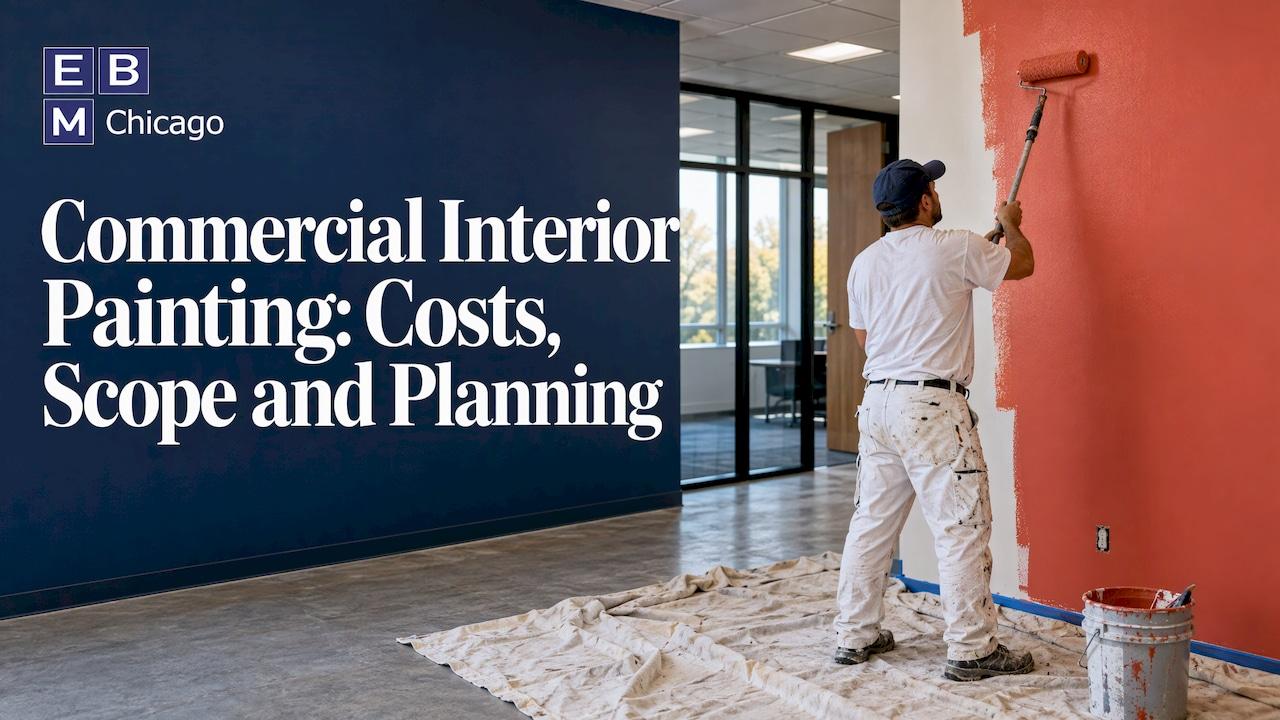
Commercial interior painting typically lands between about $1.50 and $6.50 per square foot of paintable surface, according to CalcBid's 2026 planning guide. Where your project falls in that range depends less on the paint than on preparation, the hours your crew is allowed to work, and how well painting is sequenced with everything else happening in the building. That last point is why many owners and property managers fold painting into a managed renovation scope instead of bidding it alone. At Expert Building Maintenance (EBM), a Burr Ridge, Illinois general contractor, painting sits alongside flooring, wall coverings, lighting and wall protection within projects we manage from planning through final turnover.
This guide is for the people who sign off on the work: property managers, owners, healthcare and senior living operators, and tenants taking space. It covers what the numbers mean, what moves them, and how to ask for bids you can compare.
Key Takeaways
- Plan on roughly $1.50 to $6.50 per paintable square foot for commercial interiors, with walls-only office work at the low end and healthcare or specialty rooms at the high end.
- Preparation, repairs, ceilings, trim and doors are the usual reasons two bids for the same building differ.
- After-hours work in an occupied building commonly carries a premium, so scheduling belongs in the budget from day one.
- Painting goes fastest and cleanest when it is sequenced with flooring, ceilings, millwork and dust control under one project manager.
- Ask every bidder to price the same written scope so the numbers can be compared line by line.
Table of Contents
- What commercial interior painting costs per square foot
- Cost by building type
- What is inside the price
- Why after-hours work changes the number
- Is commercial painting more expensive than residential?
- How to scope a painting project so bids compare
- Do you need a licensed painter?
- Painting as part of a larger renovation
- Planning a refresh for your building
- Frequently Asked Questions
What commercial interior painting costs per square foot
The most useful way to think about price is per square foot of paintable surface, meaning the wall, ceiling or trim area to be coated, not the floor area of the building. A 10,000 square foot office with 9-foot ceilings has far more wall area than 10,000 square feet, which is the first place budgets go wrong.
Published ranges vary because they describe different mixes of work:
- CalcBid's 2026 guide gives a broad U.S. planning range of $1.50 to $6.50 per paintable square foot, with typical project totals of $4,500 to $40,000.
- HomeGuide's 2026 commercial painting article puts the average at $2 to $6 per square foot of paintable surface.
- Public bid records compiled by Commercial Builders & Contractors show routine wall and ceiling painting at about $0.43 to $3.80 per square foot in county bids, with heavier scopes or single-bidder jobs running $5.89 to $11.70.
The spread between these sources is the lesson. A simple repaint of sound walls in an empty office sits at the bottom. A project with damaged drywall, color changes, ceilings, doors and tight working hours sits near the top. Treat any single "cost per square foot" you see as a starting point for a conversation about scope, not a quote.
Prices also move with labor and material markets, so use published figures to sanity-check a bid and rely on a written proposal for the number you budget.
Cost by building type
The room type changes the coating and the labor. CalcBid's October 2026 guide breaks planning ranges out like this, per paintable square foot:
| Space | Typical range |
|---|---|
| Warehouse walls | $1.50 to $3.50 |
| Office, walls only | $1.75 to $2.75 |
| Retail or restaurant interior | $2.50 to $5.00 |
| Office, walls plus ceilings and trim | $3.50 to $5.50 or more |
| Healthcare or specialty facility | $4.00 to $7.00 |
Source: CalcBid commercial painting cost guide.
A separate 2026 Seattle cost guide from CCR-Mag reports a similar pattern for medical space: standard medical offices at $3.50 to $6.00 per square foot and procedure or surgery suites at $5.00 to $9.00 or more. Local labor rates differ, so Chicago-area figures can sit above or below another city's, but the order of the categories holds.
Why do healthcare, senior living and dialysis spaces cost more to paint? Several reasons stack up: durable, cleanable coatings in patient rooms and corridors, careful containment so residents and patients are not exposed to dust or odor, tight sequencing around occupied rooms, and wall protection and finish details that must be coordinated with the paint. If you operate a skilled nursing or dialysis facility, paint is rarely a stand-alone task. It is one step in a room-by-room turnover plan.
What is inside the price
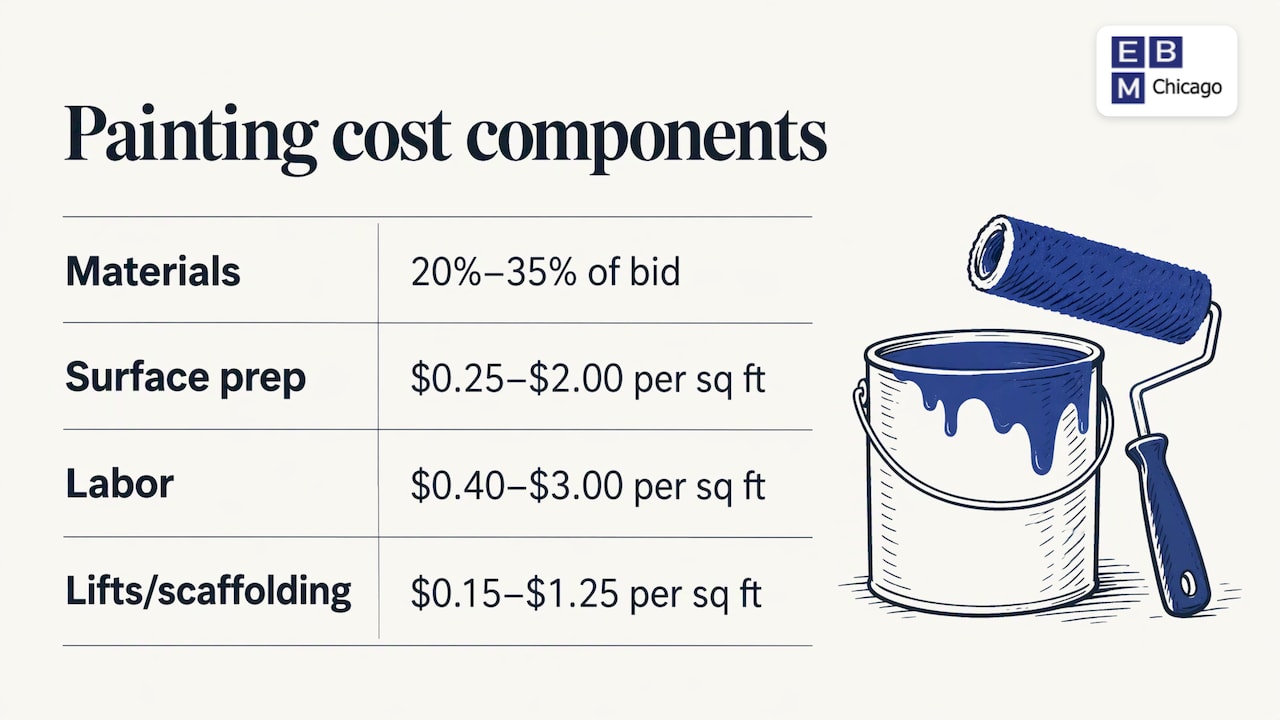
A painting bid is built from a few components. According to CalcBid's breakdown, materials make up about 20% to 35% of a commercial painting bid, surface preparation runs $0.25 to $2.00 per square foot, labor $0.40 to $3.00, and lifts or scaffolding, when needed, $0.15 to $1.25. Contractors build their own estimates from application method and productivity, labor and material costs, labor burden, overhead and profit, as described in the 2025 National Painting Cost Estimator.
Two details from that same estimator matter to you as the buyer. Its standard cost assumptions cover only minor preparation and minimum setup and cleanup. Extensive preparation, extra protection of floors and furnishings, and special equipment are added as separate allowances. So a low per-square-foot number can quietly exclude exactly the work your building needs.
Preparation and repairs
Prep is where bids diverge. Patching anchor holes, skim-coating damaged drywall, sanding glossy surfaces, priming stained or patched areas and removing old wall coverings all take labor before a brush touches the wall. In the county bids Commercial Builders & Contractors compiled, repair labor was priced separately, from $10 to $65 per hour with a $35 median for plaster and drywall repair, and doors, frames and trim were priced apart from wall surfaces.
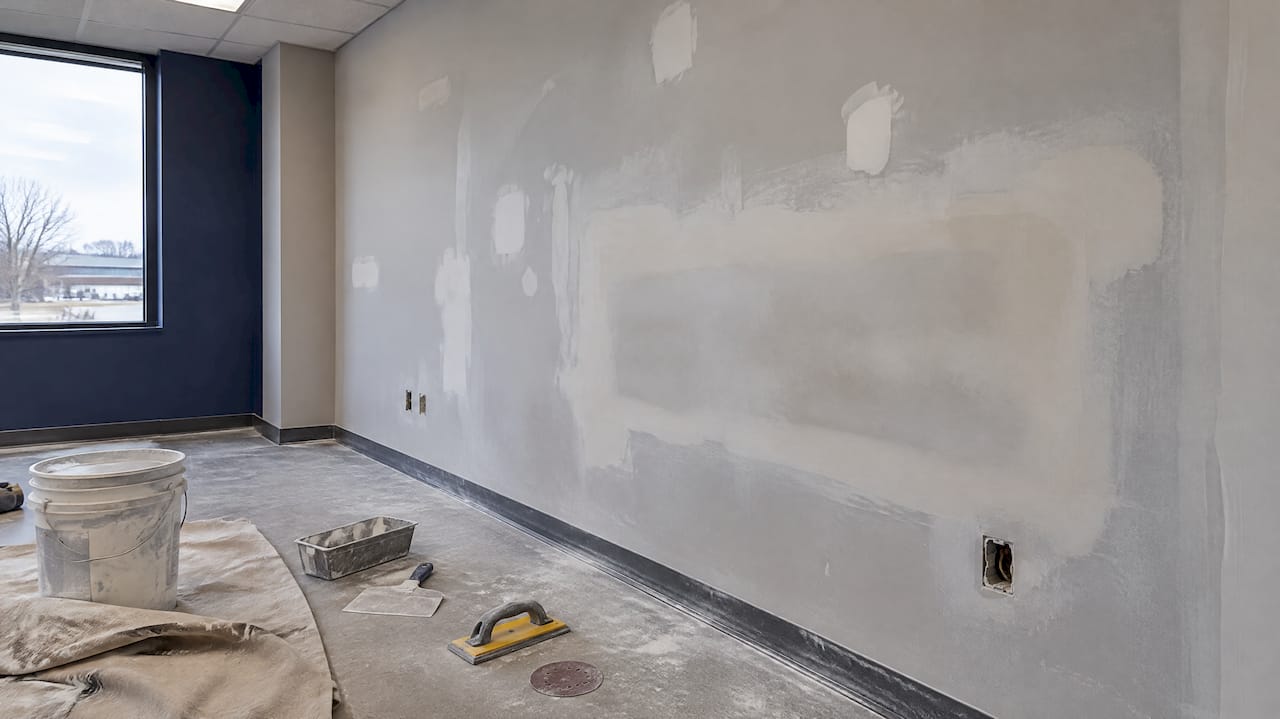
Some conditions are not a painting problem at all. If you find water-stained ceiling tiles, bubbling paint or a musty smell, the cause has to be fixed before any coating goes on, and paint over active moisture fails quickly. Moisture and mold cases often need commercial water and mold restoration before finish work can be scoped honestly.
Ceilings, trim, doors and special coatings
Walls-only is the cheapest scope on paper. Add ceilings, door frames, doors, handrails, exposed structure or specialty coatings and the per-square-foot figure rises, as the office walls-only versus walls-plus-ceilings-and-trim rows above show. Ask whether doors are priced per door or per square foot, and whether both sides and edges are included.
Access equipment
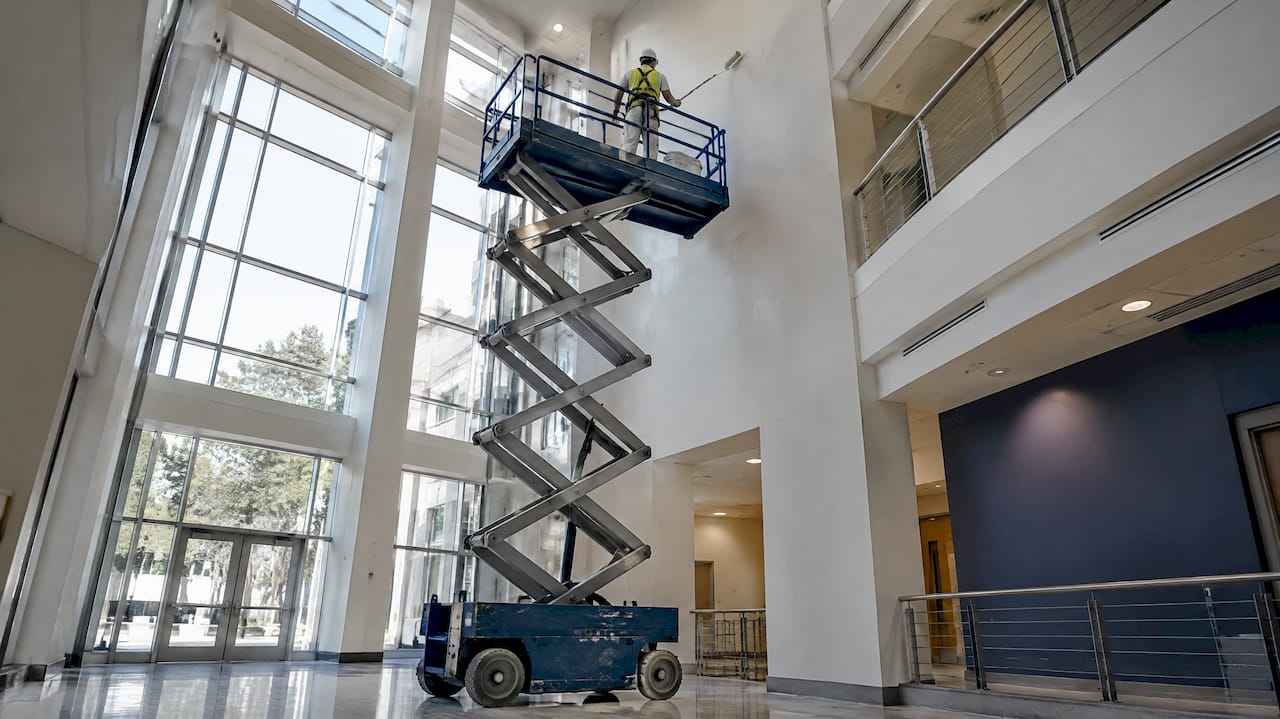
Atriums, tall lobbies and open-ceiling warehouses need lifts or scaffolding. That cost is real but easy to miss in a headline rate, so make sure it is listed as its own line.
Why after-hours work changes the number
If the building stays open, painters often work nights or weekends. In public bids reviewed by Commercial Builders & Contractors, the same county bidders priced after-hours wall work 20% to 50% above office-hours work, with a 39% median increase. The 2026 CCR-Mag Seattle guide cites a smaller 15% to 25% off-hours premium for occupied office projects. Either way, the premium is real, and it is a cost of keeping your tenants or patients undisturbed.
There are ways to manage it. Phasing the work floor by floor or suite by suite lets some areas be painted in regular hours while others stay in use. Letting the contractor close off an entire vacant suite or wing removes the premium for that area. And an honest schedule up front beats a surprise change order later. For rules on noise, access and safety in occupied properties, see our guide to after-hours construction.
Dust and odor belong in the same conversation. Sanding and patching generate fine dust, and healthcare and senior living buildings need containment so it stays out of occupied areas. Our article on construction dust control for commercial renovations covers how that is planned.
Is commercial painting more expensive than residential?
Usually the total is higher and the rate per square foot can be lower or higher depending on the job. Commercial projects cover more area, so they need more paint, labor hours and equipment, which is the main reason HomeGuide says commercial costs more than residential. The per-square-foot difference comes from what commercial work demands beyond area: scheduling around business hours, larger crews, access equipment, coatings chosen for durability and cleaning, and sometimes insurance and safety paperwork. Large open walls in an office can be efficient to paint, while a medical suite with many small rooms, doors and fixtures is slower.
How to scope a painting project so bids compare
The most common reason owners get bids that cannot be compared is that each contractor measured and assumed something different. Write the scope once and send the same document to everyone.
- Measure paintable surface. List walls, ceilings, doors, frames, trim and any special surfaces by area or count, floor by floor.
- Describe the condition. Note damaged drywall, stains, old wall coverings, previous glossy finishes and any known moisture history.
- Specify the paint system. Name the product line or performance level, primer, number of coats, sheen and color count. The SYNC Interior Painting Construction Standard lists what a submittal should identify before coatings are ordered or applied: products, substrate-specific systems, preparation, primer, coats, sheen, dry-film information and safety data sheets.
- Set the hours. State whether work is during business hours, after hours or in vacant areas, and any blackout dates such as quarter-end or patient admission cycles.
- List protection and cleanup. Ask how floors, furniture, equipment and air handling will be protected, and who handles final cleaning.
- Ask for separate lines. Preparation, repairs, access equipment, doors and trim, and after-hours premiums should each be visible.
With the same scope in hand, a bid that comes in much lower than the others is a signal to check what it leaves out, not a bargain by default.
Do you need a licensed painter?
Illinois does not appear to have a statewide license for ordinary painting contractors, so requirements are generally set by the city or county where the work happens. Because that varies, confirm requirements with the building department for your municipality, and ask for proof of general liability and workers' compensation insurance from anyone working in your building. Healthcare, senior living and condominium properties often add their own insurance and background requirements on top.
Painting as part of a larger renovation
Most commercial interiors are not painted in isolation. Paint is typically the last visible layer after demolition, drywall, ceilings, electrical, flooring and millwork. Ordering matters: ceilings before walls, walls before flooring and base, touch-up after furniture and fixtures. When separate vendors handle each step, touch-ups, scuffs and schedule gaps become your problem as the owner.
That is the situation a general contractor is built for. EBM is a full-service commercial general contractor, established in 2001, that manages projects from initial planning and demolition through construction and final turnover, with project management and trade coordination at the center. Our services include interior remodeling, flooring, painting, wall coverings, custom millwork, lighting and wall protection, and we specialize in renovating occupied buildings while coordinating construction to minimize disruption to daily operations. For a property manager, that means one point of contact for a paint refresh that also touches flooring, ceilings or code upgrades, instead of several contracts to schedule.
If your paint budget is part of a bigger plan, these guides help set it in context: commercial interior renovation in Illinois, office renovation cost per square foot and commercial renovation costs in Illinois. For timing, see our construction project timeline.
Planning a refresh for your building
Whether you are refreshing a corridor in a skilled nursing facility, finishing a tenant improvement or repainting an office floor, the best results come from deciding scope, hours and sequencing before anyone mobilizes. EBM works with business owners, property owners, property managers, healthcare operators, senior living facilities and developers on interior renovations and buildouts, from cost-effective facility upgrades to high-end renovations.
If painting is part of a larger interior project, review our commercial services or send us your scope and schedule.

Frequently Asked Questions
How much does commercial interior painting cost?
Plan on roughly $1.50 to $6.50 per square foot of paintable surface, with totals for typical projects of $4,500 to $40,000, per CalcBid's 2026 guide. Walls-only office work is at the low end, and healthcare or specialty spaces are at the high end. A written proposal for your specific scope gives the number to budget.
How do you estimate a commercial painting job?
Estimators start with the paintable area, then apply productivity rates for the application method, labor and material costs, labor burden, overhead and profit. Extensive preparation, extra protection and special equipment are added as separate allowances, as described in the 2025 National Painting Cost Estimator. Giving every bidder the same measured scope is the best way to get matching estimates.
Why is after-hours painting more expensive?
Night and weekend crews cost more, and the work is slower when areas must be cleared and reset each shift. Public bid records show premiums of 20% to 50% with a 39% median, while a 2026 Seattle guide cites 15% to 25% for occupied offices. Phasing the work or painting vacant areas first can reduce how much work falls into premium hours.
What should a commercial painting bid include?
It should list surfaces and quantities, preparation and repairs, the paint system with primer, coats and sheen, protection and cleanup, access equipment, working hours and any premium, and insurance. Asking for these as separate lines lets you compare bids fairly.